"Most will be taken with ... Duckwitz's mordant musings on
phones, fidelity, politics, and deficiencies of existence."
--Publishers Weekly (starred review)
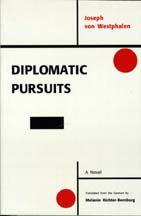
The first novel by one of Germany's leading satirists follows the thoughts and adventures of Harry von Duckwitz. Duckwitz is an aristocratic, left-leaning lawyer who suddenly leaves his law firm, enters the foreign service, and gets posted to Cameroon and Ecuador. He pursues ideas and women with the same conflicted, contrary, self-critical volatility he brings to his diplomatic career. Whether insulting or attempting to understand people, from left-wing intellectuals to right-wing colonels, he keeps stumbling across truth after half-truth.
German humor seems to be an oxymoron, but you will find yourself drawn to Westphalen's cosmopolitan irony, to the universality of his concerns and, most of all, to the all-around agnostic, questioning yet smug, semi-alter ego he has created in Duckwitz. This is a Catbird book through and through: it makes you laugh and it makes you think; it makes you angry and it makes you nod your head in agreement and realization.
$14.95 paper, 300 pages, ISBN 0-945774-28-1
"Well?!" All of a sudden there was this new greeting, drawn out and arch as a question mark. You'd be crossing the parking lot, standing in an elevator, walking through the lobby, and some colleague would call ou: "Well?!" In the cafeteria, too. Before you could even sit down, somebody was saying, "Well?!"
"What is all this nonsence?" asked Duckwitz. . . . It took a while for Duckwitz to figure out what they meant. In May of 1989, the Hungarians cut through the barbed wire at the Austrian border without so much as a by-your-leave. It was the beginning of European Communism's bankruptcy proceedings. Things happened so fast that just six months later, when the Berlin Wall fell, the process was as good as complete. . .
"Well?!" It was an exclamation, a comment, and a rhetorical question all rolled into one. Rightists in particular enjoyed throwing it at leftists. . . ."Well?!" It was the discreet cry of a winner not yet sure of his victory. There was a touch of gloating in it, a certain sense of triumph: Well, what do you have to say now? Well?! It looks like you bet on the wrong horse! Well?! You certainly look pretty foolish! Well?! Now I guess the cat's got a good hold of your tongue!
When two of the more conservative diplomats ran into each other, the emphasis was different. The exclamation was shorter, less arch: "Well!" A brief confirmation. An exclamation marks a victory. "Well!" We certainly showed them! And then there was the unemphatic, almost shy "Well" of the losers. With two question marks, "Well??" What are we going to do now? . . .
The events of that summer and fall, constantly extolled as historic, gave Duckwitz another opportunity to mock German ways and freshen up his image. Now that being a leftist was growing increasingly unpopular, being one gave him special pleasure . . . .
At a morning meeting, someone solemnly reported on one of the Foreign Minister's great fears. Some of the people at the meeting began to feel very grand. For just a moment, diplomacy appeared to have a higher meaning. Then there was muffled laughter from somewhere near Duckwitz. He had whispered to his neighbors that political intercourse between the two German states was at the least a violation of the rules of the kama-sutra. Good lovers, he said, no matter how strong the urge, make time for foreplay. "This is just pitiful," said Duckwitz. "They're all suffering from ejaculatio praecox."
Colleagues who thought you shouldn't make jokes about something as sacred as the German nation tried to rise above Harry's leftist indescretions by ignoring them. And every time another leftist politician was swept away and leftist illusions crumbled a little more - about once a week - they took their revenge by calling out the word of the season with particularly snide satisfaction: "Well?!" As if he had ever had any illusions. As if he had ever put his money on communism.