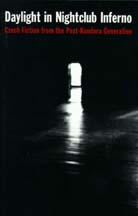
The opening up of the Prague Spring in the mid-1960s set off one of the great literary explosions of this century, led by such writers as Milan Kundera, Václav Havel, Bohumil Hrabal, Josef Škvorecký, Vladimír Páral, and Ivan Klíma. No other small language has been better represented in English.
But what has been happening since the Velvet Revolution of 1989? And who are the writers who are hoping to replace the Prague Spring generation?
Are the Czechs looking back or forward, inside or abroad, shallow or deep? Is there a new Czech style, a new sense or humor, new themes, new complaints? Are Czech women coming to the fore at last? In short, what's the story?
Daylight in Nightclub Inferno is Catbird's attempt to give at least a good part of the story. It was the first English-language collection of stories and novel excerpts by the best and most representative younger Czech writers. You will discover that, unlike the older generation, they have not been disillusioned; their darkness comes not from the disappointment of hopes, but from never having had any. The daylight in the title refers to the quality of the writers' work and to the fact that they could publish it freely, even if it became harder to get the attention of readers faced with so many new alternatives. This collection also introduced a new generation of American Czech-into-English translators. And it contains a few bonus selections from excellent members of the older generation who somehow were passed over.
320 pp., $3 e-book. ISBN 0-945774-33-8. Available only as an e-book.
An e-book of Daylight in Nightclub Inferno can now be purchased directly from Catbird Press in PDF, EPub, or MOBI (Kindle) formats for $3.
Payment is via Pay Pal (our Pay Pal e-mail address is catbird@pipeline.com). Include a note in your payment, such as
"Please send a (format name) of Daylight in Nightclub Inferno to (your e-mail address)" or send a separate e-mail to info@catbirdpress.com,
which we can respond to with the e-book attached.
 Catbird Homepage | Czech Literature | Catbird Authors | Catbird Links | Catbird Titles