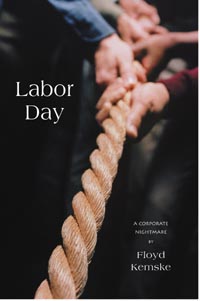
Kemske's Latest Novel!
"Floyd Kemske is drawing the surreal map of the modern workplace.
Every spot is marked, 'You Are Here,' and from it there is no finding your way home."
--Denver Post
"Kemske has humorously and humanely welded together farce and postindustrial angst, with charming results."
--Publishers Weekly
"[A]n entertaining look at the tribulations of working stiffs, wherever they toil."
--New York Times Book Review
Labor Day is the stepchild of holidays. It signifies the end of summer. The beginning of school. Going back to work everyone's favorite four-letter word not what we want to celebrate, at least if we've got a job.
Floyd Kemske's wryly nightmarish novels don't quite celebrate work, but his fantasies certainly do get deep into the realities of the lives we lead at work: office politics, reorganizations, the management of people by other people. And they entertain as they disconcert.
Labor Day is Kemske's fourth novel about the business world and his fifth novel overall. A young, unconventional union organizer, Gregg Harsh, has decided to unionize the headquarters staff of a large national union. In order to stop the unionizing effort, the president of the national union, Harvey Lathrop, asks his greatest adversary, union-buster Stillman Colby, to come out of retirement. Colby's wife is fiercely opposed to Colby's donning his business suit again and going out to battle. And then their marriage becomes even more imperiled.
In Kemske's hands, what sounds like cut-and-dry drama (or possibly farce) is turned into a darkly comic labor of lies. Each of the characters bases his life on a set of ideals, but it is hard to tell the difference between ideals and desires as the characters manipulate and undermine each other and sometimes themselves. Beneath the conflict, humor, and passions, Labor Day is sad in its depiction of what people will do to defend and to spread their psychological turf.
$22, 202 pages, ISBN 0-945774-48-6
Now available as a free PDF
Suitable for transferring to Amazon Kindle and Sony Reader Digital Book. Just click here to download.
Labor Day by Floyd Kemske is licensed under a
Creative Commons Attribution-Noncommercial 3.0 Unported License.
To read the first chapter of Labor Day, click here.
or just read a short excerpt from the novel, below,
after the excerpts from reviews of Floyd Kemske's other novels.
Praise for the Novels of Floyd Kemske
"Floyd Kemske understands that some of what's going on in corporate America is so horrible
that only fantasy can adequately depict it. He deserves to be read
by everyone who has worked for a company and lived to regret it."
--Cleveland Plain Dealer
"Like the best black comedy, Kemske creates worlds of the imagination that make the reader
first laugh, then blanch, and then grasp the painful plausibility."
--Boston Phoenix Literary Supplement
"Kemske, who may have started a new 'management novel' genre with Lifetime Employment, continues in that intriguing vein [in The Virtual Boss], creating the most perfect hell since Dante's Inferno and the most intriguing computer character since HAL in 2001." --Library Journal
"[Human Resources is] a wonderfully ambiguous and deliciously wicked tale
leavened by humor in ajugular vein." --Kirkus Reviews
"This tale of the Enlightenment's bitter end [The Third Lion] finds an apt teller in Kemske, who brings the irony and psychological acuity that his formidable protagonist demands."
--Publishers Weekly
"Told in a dry, matter-of-fact way, [Lifetime Employment] is a black comedy,
both hilarious and horrifying."
--St. Louis Post-Dispatch
"There is more truth in [The Virtual Boss] than in all the consultants' babble for the next 12 months.
Oh, how I wish they would put him on the cover of Business Week!"
--David Warsh, Business Columnist, Boston Sunday Globe
"There are shades of Orwell, Kafka, and Woody Allen's Sleeper in The Virtual Boss.
Its scathing assessment of the corporate mentality is dead-on."
--Wired
"The Virtual Boss is a grimly funny parable, a timely novel." --Los Angeles Times
"[The Virtual Boss is] a terrific read that crosses boundaries and will appeal to readers of all stripes."
--Boston Sunday Herald.
Excerpt from Labor Day
They arrived at a desk that was easily the messiest work space Colby had ever seen. The desk was littered with notes, photocopies, letters, magazines, software manuals, folders, doubled-over books with broken spines. There were business cards, DVDs, direct-mail flyers, yellow legal pads with curling sheets on top, pencils, pens, three-ring binders, and a road map of Ontario.
"Have a seat," said Kathleen. "He'll be with you in a couple minutes."
The only chair was the one behind the desk. Colby sat in the chair and tried to gather his wits from the sensory bombardment he'd just suffered.
"Ah, there you are."
He looked up and saw the human counterpart of the messy desk he was sitting at. His suit fit him in the shoulders like collapsed negotiations and in the sleeves like binding arbitration. He needed a haircut, and his necktie looked like he left the knot in it when he took it off. The lenses of his glasses were tinted pink, and Colby realized with a start that they were rose-colored.
Colby rose partway from the seat.
"Don't get up." Lathrop raced over to him and shoved him back down in the chair. He was stronger than he looked. Lathrop took his right hand and gave it a single shake. "We meet at last." His voice was ironic, and Colby realized he had not expected an ironic man.
"May I get you anything?" said Lathrop. But before he could answer, Lathrop answered for him. "A cup of tea." He hustled away.
Colby didn't like tea, but he realized it was easier for Lathrop to be doing anything other than talking with Colby about his problem.
Lathrop returned a few moments later carrying two mugs of steaming tea. He handed Colby a mug, then sat on a pile of memos on the desk in front of him. He looked more like he should be running a software company than a labor union.
Before Colby could start the conversation, they were interrupted by a young woman who appeared behind Lathrop. She was about the same age as the woman who had brought Colby to this desk, but she was dressed for work in an office rather than a circus.
"Excuse me, Dr. Lathrop," she said.
Lathrop turned. "Yes, Lauren. What is it?"
She handed him a clipboard. "This week's chalupas."
Lathrop took the clipboard and signed it. He handed it back to Lauren and waved her away. He turned back to Colby.
"The employees get hot chalupas at their desks every day. It's surprising how much of your time something like that takes up."
"What are chalupas?" said Colby.
"They are some kind sandwich or something," said Lathrop. "Mexican style."
"You give the employees hot food at their desks?" said Colby.
"Just chalupas," said Lathrop. "They love them. I've never tried one myself."
Colby had never heard of such a thing. This assignment was going to be unlike anything he'd ever done before.
"They tell me you think your organization is the object of an organizing effort," said Colby.
Lathrop's expression clouded. "I take it you find this amusing."
"I didn't say that," said Colby.
"We had better acknowledge our history, Mr. Colby," said Lathrop. "Otherwise, it will come out unexpectedly and bite us."
"Please call me Cole, Dr. Lathrop."
"Would that make you feel more comfortable?" said Lathrop.
"We'll probably have to work fairly closely together," said Colby.
"Fine," said Lathrop.
The two sat in an uncomfortable silence for a moment.
Colby realized that Lathrop's embarrassment was a major component of the cloud that hung between them.
"You should call me Harv," said Lathrop at last.
Colby kept himself from sighing with relief. Getting on a first-name basis with his former adversary seemed a major step. He was glad it was behind him.
Lathrop was obviously still embarrassed, but he was too big a man to allow embarrassment to get in the way of business. "You have to understand our position here, Cole." He sipped his tea, then continued. "We have a fiduciary responsibility to our members. We owe them the most efficient possible use of our operating resources, which come from them in the form of dues."
Colby had always thought of labor unions as businesses, but he had never thought about the customer service aspect before. Of course they would have to be as responsive to their members as any business was to its customers. He was beginning to uncover the concept of the new philosophy he needed, so he pushed Lathrop for more insight.
"Surely your members couldn't object to the headquarters employees belonging to their union?" he said.
Lathrop shook his head emphatically. "The Department of Labor will not allow the union's employees to belong to FOW. We would be negotiating the employment contract with ourselves, you see."
Of course. If the employees at this site joined FOW, it would be no better than a company union, and even Colby recognized the company union as a discredited tool for fighting unionization.
"So what are we to do, then?" continued Lathrop. "We cannot cede representation of our employees to outsiders. We're up against our fiduciary responsibility again."
There was much more here than a comic situation. The interests of the union's members was an angle he had not thought of. The phrasing of his hand-holding argument began to form in his head. The members of FOW rely on you to protect their interests. They want their union to provide the services it is supposed to provide, not get mired in contract negotiations, formal work procedures, and excessive pay scales.
"Has this union called you?" he said to Lathrop.
"No."
"How do you know it's trying to organize you?"
"We've seen the signs," said Lathrop. "Employees taking their breaks in groups. People trying to get names and addresses of other employees. We've organized enough sites ourselves to recognize it when it has begun. And one of my vice presidents found this in the trash." He pulled a crumpled flyer from his jacket pocket and handed it to Colby.
Colby found a bare spot on the desk and smoothed the flyer out. It had a stylized human eye on it. Under the eye was the acronym IBOL, and Colby realized the acronym was meant to be pronounced. It was actually rather clever. When he looked up at Lathrop again, he saw his client was not looking at him.
Lathrop actually had his head down, and his hand grasped his forehead, covering his eyes.
Colby realized the man didn't know he was looking at him. He looked back down at the brochure again, embarrassed, then said something to give Lathrop a chance to collect himself.
"I like FOW's brochures better."
He looked up at him again. Lathrop had collected himself to smile, but the strain showed on his face.
"I've tried to treat them like family, Cole," he said. "I don't know why they would do this to me."
Colby started to tell him not to take it personally, which is what he usually told clients in this situation, but he realized it would sound hollow, maybe even patronizing.
"Tell me, Harv, are you aware of any of your employees signing union membership cards?"
"No."
"You haven't identified a single one?" said Colby.
Lathrop said nothing for what seemed several moments. Then he set down his tea. "I'd have fired anybody who signed one."