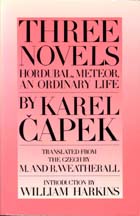
"Enjoyable philosophical novels can be counted on a hand or two. ...
Now, American readers can add to this skimpy list this obscure but thoroughly deserving trilogy."
—Dennis Drabelle, Washington Post Book World
"One of the most successful attempts at a philosophical novel in any language."
—René Wellek
"Čapek's masterpiece."
—Joseph Coates, Chicago Tribune
This trilogy of novels was the culmination of Karel Čapek's career. The novels share neither characters nor events; instead, they approach the problem of knowing people — of mutual understanding — in a variety of ways. Detectives faced with a murder reconstruct the crime, but not the character of the man who was murdered. Three people tell stories about a dying pilot they know almost nothing about; each story is as full of truth as it is devoid of facts. And one man looks back on his life and discovers all the people he might have been. Together, these three short novels form a readable philosophical novel unique in world literature.
$10 e-book, 480 pp.. Only available as an e-book.
An e-book of Three Novels can now be purchased directly from Catbird Press in PDF, EPub, or MOBI (Kindle) formats for $10.
Payment is via Pay Pal (our Pay Pal e-mail address is catbird@pipeline.com). Include a note in your payment, such as
"Please send a (format name) of Three Novels to (your e-mail address)" or send a separate e-mail to info@catbirdpress.com,
which we can respond to with the e-book attached.
Catbird Homepage | Catbird Specialty Areas | Catbird Authors | Catbird Titles | Catbird Links